Knowledge Base
Research Library
Scientific profiles, research guides, and reference data for every compound in the CoreAxis catalog. Built for researchers, by researchers.
What are research peptides?
Peptides are short chains of amino acids linked by peptide bonds — the molecular vocabulary cells use to signal, regulate, and repair. Research peptides are synthetic analogues or fragments of naturally occurring peptides, produced under controlled laboratory conditions to support scientific investigation into biological pathways that are difficult to study with conventional small-molecule compounds.
The compounds in the CoreAxis catalog span five primary research categories: repair and recovery, metabolic signaling, growth hormone secretagogue activity, cognitive and neuroprotective pathways, and anti-aging and longevity biology. Each compound is supplied as a lyophilized powder, blend, drop formulation, or raw material — all produced to a minimum 99% purity standard and independently tested prior to listing.
All products sold by CoreAxis Peptide are for in-vitro laboratory research only. They are not intended for human or veterinary use. Researchers should consult the relevant scientific literature and their institution’s ethics and compliance frameworks before beginning any study involving these compounds.
CAP-R Series
Repair & Recovery Research
The repair and recovery category contains compounds studied primarily for their roles in tissue remodeling, angiogenesis, wound healing, and musculoskeletal integrity. Two compounds dominate this research area and constitute the most requested compounds in the entire catalog.
CAP-R1 BPC-157
BPC-157 (Body Protection Compound 157) is a synthetic pentadecapeptide derived from a protective protein isolated from human gastric juice. Its 15-amino-acid sequence — Gly-Glu-Pro-Pro-Pro-Gly-Lys-Pro-Ala-Asp-Asp-Ala-Gly-Leu-Val — has no known naturally occurring equivalent at this length, making it a compound of particular research interest.
Animal model research has focused heavily on BPC-157’s interaction with growth factor receptor systems, particularly VEGFR2, which positions it within angiogenesis and vascular repair studies. Separate lines of research have examined its effects on the gastrointestinal mucosa, tendon and ligament healing, and dopaminergic and serotonergic systems in neuroprotection models. Its molecular weight of 1419.56 Da places it firmly in the mid-range peptide class, soluble in sterile or bacteriostatic water with a working stability of approximately two weeks at 4°C following reconstitution.
CAP-R2 TB-500 (Thymosin Beta-4)
TB-500 refers to the full 43-amino-acid sequence of Thymosin Beta-4, a ubiquitous intracellular peptide found in high concentrations in blood platelets and wound fluid. Its primary biological function involves the sequestration of actin-G monomers, modulating cytoskeletal dynamics in ways that promote cellular migration — a fundamental prerequisite for wound closure and tissue remodeling.
Research has investigated TB-500 across a broad range of models including corneal wound healing, cardiac tissue recovery following ischemia, dermal wound contraction, and hair follicle cycling. Its upregulation of matrix metalloproteinase-2 (MMP-2) is a commonly studied downstream effect. At 4963.44 Da, it is substantially larger than most peptides in this catalog and requires careful handling — reconstituted solutions should be used within one week and not subjected to repeated freeze-thaw cycles.
CAP-R1B Recovery Blend
The Recovery Blend combines BPC-157 and TB-500 in a single lyophilized vial, positioned for researchers investigating whether the two compounds produce additive or synergistic effects across their complementary tissue repair mechanisms. BPC-157 operates primarily through the VEGFR2 angiogenesis pathway, while TB-500 functions through actin sequestration and MMP-2 upregulation — creating a logical basis for dual-pathway repair studies. Researchers should account for both compounds when designing dosing protocols and interpreting results.
CAP-M Series
Metabolic Research
The metabolic category comprises compounds studied in the context of fat metabolism, lipolysis, adipogenesis, and intracellular energy signaling. Both compounds in this series operate through distinct, well-defined molecular targets that have attracted considerable attention in obesity and metabolic disease research.
CAP-M1 AOD-9604
AOD-9604 is a modified synthetic fragment corresponding to the C-terminal region of human growth hormone, specifically the 176–191 amino acid sequence, with a tyrosine residue added at the N-terminus to enable study of its independent activity. Early research sought to isolate the lipolytic properties of hGH without reproducing its mitogenic or diabetogenic effects, and AOD-9604 emerged as the primary candidate for this purpose.
Studies conducted primarily in rodent models have found that AOD-9604 stimulates lipolysis through a β3-adrenergic receptor-dependent mechanism and inhibits lipogenesis in adipocytes. Critically, it does not appear to elevate IGF-1 levels — a key differentiator from full hGH that has made it a useful tool in metabolic pathway studies seeking to isolate individual growth hormone functions. A separate body of research has examined its potential in cartilage and bone repair models, expanding its research profile beyond metabolic biology.
CAP-M2 5-Amino-1MQ
5-Amino-1-methylquinolinium (5-Amino-1MQ) is a small-molecule inhibitor of nicotinamide N-methyltransferase (NNMT), an enzyme that transfers methyl groups from S-adenosyl methionine (SAM) to nicotinamide, reducing the cellular availability of both SAM and NAD⁺. By inhibiting NNMT, 5-Amino-1MQ research aims to understand whether increasing intracellular SAM and NAD⁺ can reverse metabolic dysfunction in adipose tissue.
Notably, 5-Amino-1MQ is a small molecule rather than a peptide — its molecular weight of 174.20 Da places it in a different compound class from the rest of the catalog. This distinction matters for solubility: unlike most peptides in the CAP series, 5-Amino-1MQ requires DMSO as a primary solvent. Its research profile also intersects with stem cell biology, with studies investigating its effect on activating dormant satellite cells in skeletal muscle tissue.
CAP-G Series
Growth Factor Research
Growth hormone secretagogue research investigates how synthetic peptides can stimulate the pituitary gland’s natural GH release without introducing exogenous growth hormone. The CAP-G series contains two of the most extensively studied compounds in this field, as well as a blend formulation designed for dual-receptor activation studies.
CAP-G1 CJC-1295 (No DAC)
CJC-1295 is a synthetic analogue of growth hormone-releasing hormone (GHRH), the hypothalamic peptide responsible for stimulating pituitary GH secretion. The No-DAC variant — supplied without the drug affinity complex modification — preserves the natural pulsatile GH secretion pattern rather than producing tonic GH elevation, which is considered experimentally preferable for most GH secretagogue research protocols.
CJC-1295 binds and activates the GHRH receptor on pituitary somatotrophs, producing downstream GH release and subsequent IGF-1 upregulation. At 3367.97 Da, it represents a mid-large peptide with good stability in lyophilized form and approximately two weeks of usable stability post-reconstitution when stored at 4°C.
CAP-G2 Ipamorelin
Ipamorelin is a synthetic pentapeptide and selective agonist of the growth hormone secretagogue receptor (GHSR-1a), the receptor through which ghrelin stimulates GH release. What distinguishes Ipamorelin from other GHSR agonists is its high selectivity — research consistently demonstrates that it stimulates GH release without producing measurable increases in prolactin, cortisol, or ACTH, side effects commonly associated with earlier-generation GH secretagogues such as GHRP-2 and GHRP-6.
At 711.87 Da, Ipamorelin is one of the smaller compounds in the catalog, which contributes to its straightforward reconstitution and solution stability. Its combination with CJC-1295 is among the most studied secretagogue stacks in GH research, with the two compounds operating through distinct but complementary receptors.
CAP-C Series
Cognitive Research
The cognitive research category contains neuropeptides studied for their effects on neurotrophic factor expression, neuroprotection, and the modulation of stress-response and anxiety pathways. Both compounds in this series originate from Russian pharmacological research programs and have accumulated substantial preclinical literature over several decades.
CAP-C1 Semax
Semax is a synthetic heptapeptide analogue of the ACTH 4–7 fragment, extended with a Pro-Gly-Pro sequence that confers resistance to enzymatic degradation. Developed at the Institute of Molecular Genetics in Moscow, Semax has been studied primarily for its effects on brain-derived neurotrophic factor (BDNF) and nerve growth factor (NGF) gene expression — two neurotrophins fundamental to neuronal survival, plasticity, and repair.
Research has investigated Semax in models of cerebral ischemia and hypoxia, where BDNF upregulation may confer neuroprotective effects. Separate studies have examined its modulation of the serotonergic and dopaminergic systems, and its potential role in memory consolidation and spatial learning models. Its molecular weight of 758.85 Da and good solubility in sterile saline or water make it a straightforward compound to work with in laboratory settings.
CAP-C2 Selank
Selank is a synthetic heptapeptide derived from the immunomodulatory peptide tuftsin (Thr-Lys-Pro-Arg), with a Pro-Gly-Pro stabilizing sequence appended at the C-terminus. Its research profile is primarily anxiolytic, with studies focusing on its modulation of GABAergic receptor activity and its role in stabilizing enkephalins — endogenous neuropeptides involved in pain modulation and emotional regulation — by inhibiting their enzymatic degradation.
Research has also examined Selank’s interaction with the hypothalamic-pituitary-adrenal (HPA) axis, investigating how it modulates cortisol and other stress-response markers under chronic stress conditions. It is commonly studied in combination with Semax (CAP-C1B blend) to investigate whether cognitive enhancement and anxiolytic effects are additive or synergistic when both compounds are present simultaneously.
CAP-A Series
Anti-Aging & Longevity Research
The longevity and anti-aging research category contains some of the most biochemically diverse compounds in the catalog — ranging from a tetrapeptide telomere biology research agent, to a copper-binding tripeptide with tissue remodeling properties, to a 28-amino-acid immunomodulatory peptide. What unifies them is a research focus on biological mechanisms associated with cellular aging, immune senescence, and structural tissue decline.
CAP-A1 Epithalon
Epithalon (Epitalon) is a synthetic tetrapeptide — Ala-Glu-Asp-Gly — representing a synthetic analogue of Epithalamin, a polypeptide originally extracted from bovine pineal gland preparations. Its primary area of study is telomere biology: research has investigated Epithalon’s capacity to activate telomerase, the enzyme that extends telomere sequences at chromosome ends, and the downstream implications for cellular replication limits and organismal longevity.
Beyond telomere research, studies have examined Epithalon’s influence on pineal melatonin secretion and circadian rhythm regulation, as well as its effects on antioxidant enzyme activity. At only 390.38 Da, it is among the smallest peptides in the catalog, with high solubility and excellent stability in lyophilized storage conditions.
CAP-A2 GHK-Cu
GHK-Cu is a naturally occurring copper-binding tripeptide — Gly-His-Lys complexed with Cu²⁺ — first isolated from human plasma and found in high concentrations at sites of tissue injury. Its biological function in wound repair has been recognized for several decades, but research interest has expanded considerably as studies have characterized its broad gene regulatory activity: GHK-Cu is reported to modulate the expression of over 4,000 human genes across wound healing, anti-inflammatory, antioxidant, and anti-tumor pathways.
Laboratory research with GHK-Cu has concentrated on collagen I, III, and VI synthesis upregulation; hair follicle enlargement and cycling; superoxide dismutase and catalase antioxidant enzyme induction; and TNF-α and IL-6 inflammatory cytokine modulation. It is light-sensitive and should be stored in amber conditions post-reconstitution. Researchers should use metal-free buffer systems to avoid copper displacement from the chelate complex.
CAP-A3 Thymosin Alpha-1
Thymosin Alpha-1 is a 28-amino-acid N-terminal fragment of prothymosin alpha, produced naturally by thymic epithelial cells and found at nanomolar concentrations in human blood. Its central research area is immunomodulation — specifically the maturation and differentiation of T-cells from progenitor cells in the thymus, and the activation of natural killer and dendritic cells in adaptive immune response models.
At 3108.36 Da, it is one of the larger peptides in this catalog and requires careful handling. Research has examined its utility as an adjunct in antiviral immune response models and has increasingly focused on immune senescence — the progressive decline in immune function associated with aging — as a potential research application. It should be reconstituted in sterile water or phosphate-buffered saline at pH 7.0–7.4 for optimal stability.
Laboratory Practice
Handling, reconstitution, and storage
All compounds in the CoreAxis catalog are supplied as lyophilized powders unless otherwise specified. Lyophilization removes water through sublimation under vacuum, producing a stable cake or powder that remains chemically intact for extended periods when stored correctly. For the majority of compounds in this catalog, the correct storage temperature for lyophilized material is -20°C, protected from light and moisture. Once reconstituted, most peptide solutions should be stored at 4°C and used within one to two weeks, depending on the specific compound.
Reconstitution should be performed by injecting the chosen solvent slowly down the interior wall of the vial rather than directly onto the powder. The vial should then be gently swirled — not shaken or vortexed — until the powder is fully dissolved. Most peptides in this catalog reconstitute readily in bacteriostatic water (sterile water containing 0.9% benzyl alcohol), which is the recommended solvent for the majority of CAP-R, CAP-G, CAP-A, and CAP-C series compounds. Semax and Selank are also compatible with sterile saline. GHK-Cu is an exception — it should be reconstituted in metal-free sterile water only, as copper in the buffer can displace the chelated Cu²⁺ and alter the compound’s activity. 5-Amino-1MQ requires DMSO as a primary solvent due to its small-molecule, non-peptide chemistry.
Researchers should minimize the number of freeze-thaw cycles for any reconstituted peptide solution. Beyond three cycles, structural integrity and purity cannot be guaranteed. Aliquoting into single-use volumes prior to freezing is strongly recommended for any compound that will not be used within a few days of reconstitution.
Quality Assurance
Reading a Certificate of Analysis
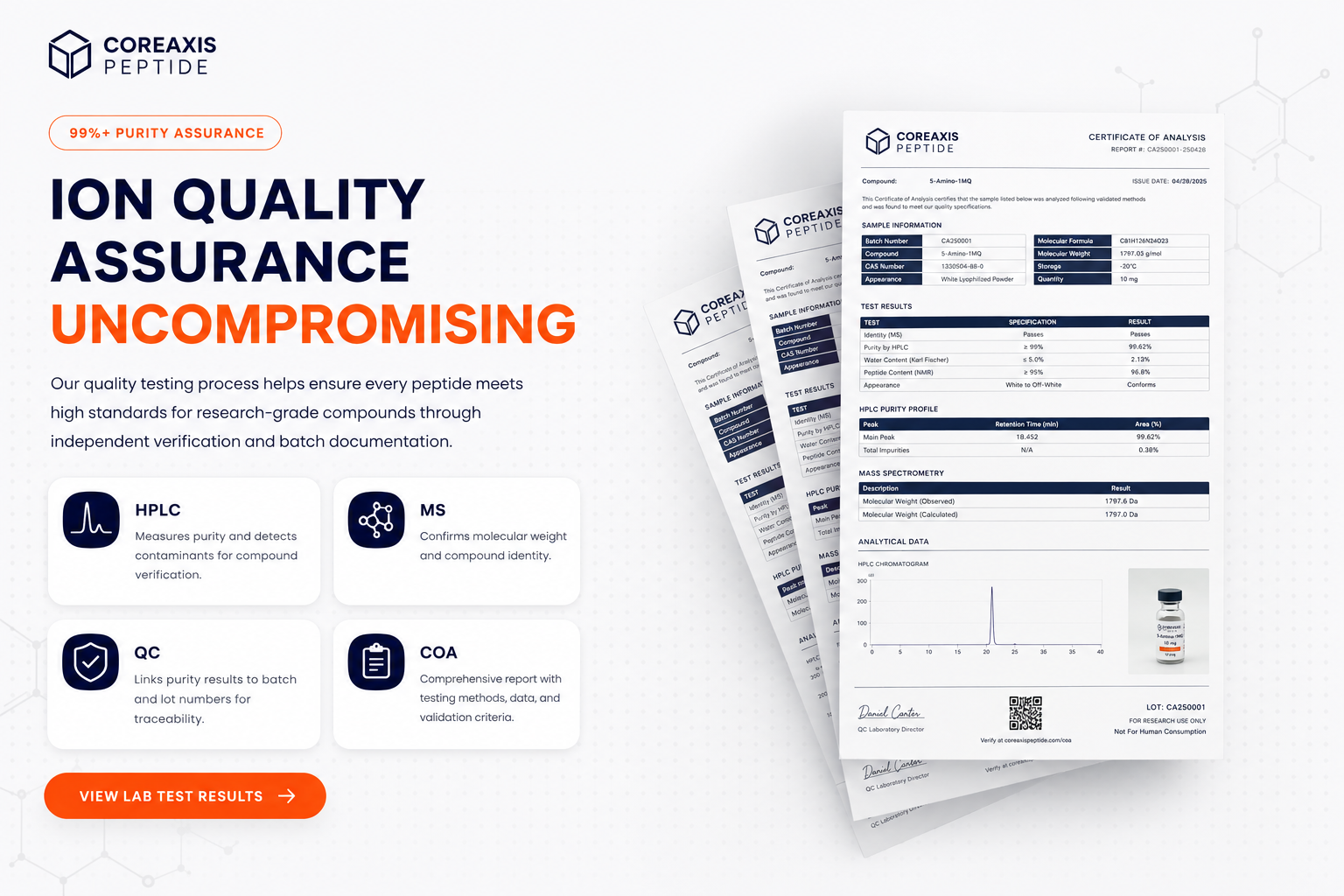
Every compound in the CoreAxis catalog is accompanied by a batch-specific Certificate of Analysis (COA) produced by an independent, accredited third-party laboratory. A COA serves as the primary quality assurance document — it confirms that the material shipped matches the stated compound identity, meets the stated purity threshold, and is free from specified contaminants. Understanding how to interpret a COA is an important baseline skill for any researcher working with synthetic peptides.
The most important figure on any HPLC-based COA is the purity expressed as an area percentage — typically written as something like “99.4% (area)”. This figure represents the proportion of the chromatographic signal attributable to the target compound versus all other peaks detected. A purity of 99% or above indicates a research-grade material. Retention time is the other key HPLC output: the time taken for the compound to travel through the column should match a reference standard within an acceptable tolerance, confirming that the peak being measured corresponds to the correct compound and not an impurity of similar molecular weight.
Mass spectrometry (MS) results on a COA confirm molecular identity at the atomic level. The observed mass-to-charge ratio (m/z) should match the theoretical value calculated from the molecular formula within ±0.5 Da. A COA that shows both HPLC purity ≥99% and MS identity confirmation within this tolerance provides strong independent verification of compound quality. All COAs in the CoreAxis library are publicly accessible from the COA Library page — no account or request is required to download a report.
Compliance
Research Use Only
All products sold by CoreAxis Peptide are classified as Research Use Only (RUO) under 21 CFR 809.10(c). This designation has a precise legal meaning: these compounds are intended solely for in-vitro laboratory research and scientific study by qualified researchers. They are not approved by the FDA or any equivalent regulatory body for use as pharmaceutical drugs, food additives, dietary supplements, or veterinary medicines. They must not be administered to humans or animals.
By purchasing from CoreAxis Peptide, the buyer confirms that they are a qualified researcher aged 21 or older, that the compounds will be used exclusively for lawful scientific research, and that the buyer’s institution has any applicable ethics or compliance approvals in place. CoreAxis Peptide accepts no liability for misuse of its compounds outside an approved research context. If you have any questions about compliance or appropriate research applications, contact our team before placing an order.